
Nowadays, electricity costs are rising continuously, and the adoption of solar is being accelerated across India. Numerous houses in Haryana are now actually shifting toward rooftop solar systems in order to reduce long-term electricity expenses and then move towards cleaner energy solutions.
Haryana is also emerging as one of the important solar-focused states in India, and is supported by strong policies, subsidy schemes, along with ambitious renewable targets.
As per the Haryana Solar Power Policy, the state aims to significantly expand its capacity by 2030 through rooftop solar systems, utility-scale projects, along with solar-powered agricultural initiatives.
In order to support this transition, both the Central Government as well as the Haryana Government are providing truly attractive subsidies under schemes like PM Surya Ghar Muft Bijli Yojana, and this makes solar installation even more affordable and residential users.
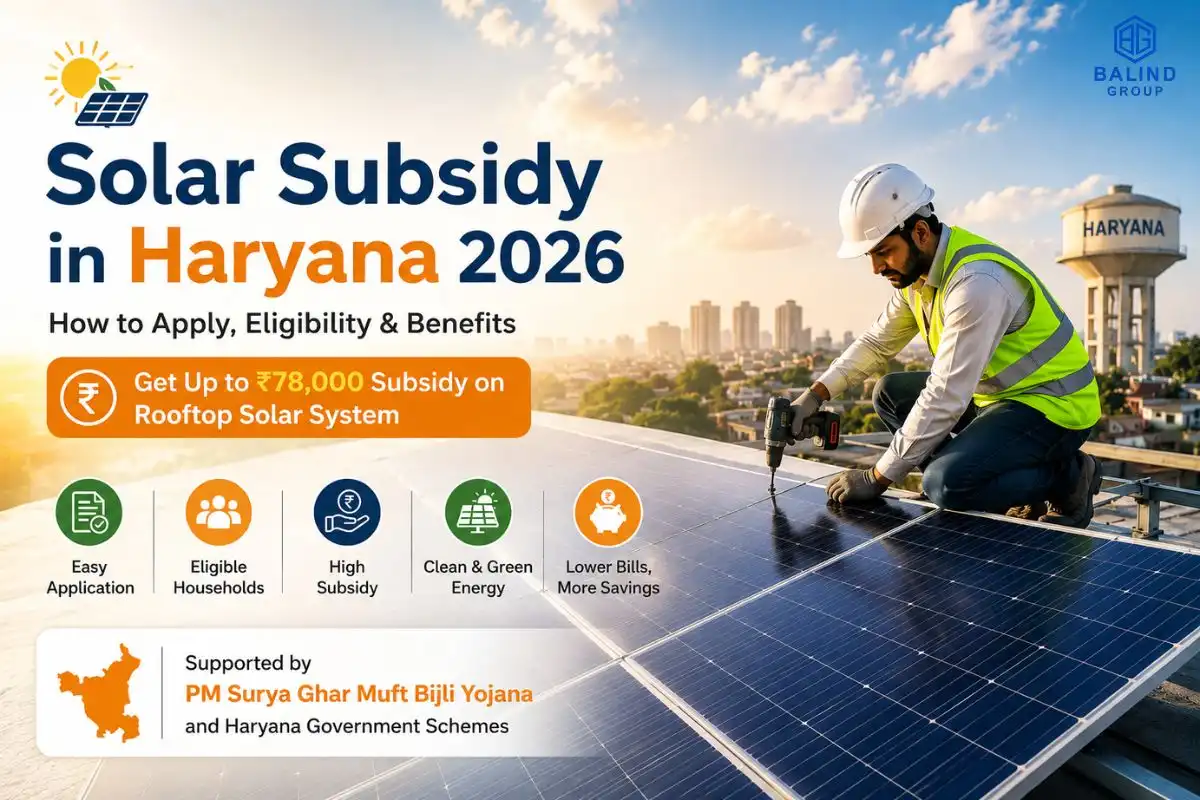
Under the ongoing subsidy structure, homeowners who are eligible homeowners in Haryana can get up to Rs. 78,000 for rooftop solar installation and additional state-level financial support for selected families.
In this detailed guide, we’ll explore everything about the solar subsidy in haryana 2026. We’ll also take a look into subsidy amounts, eligibility criteria, application procedure, needed documents, installation steps, government schemes, along with key benefits of switching to solar energy.
PM Surya Ghar Subsidy in Haryana 2026
Under the PM Surya Ghar Muft Bijli Yojana, residents of Haryana can receive subsidies based on the capacity of the solar system installed.
| Solar System Capacity | Subsidy Amount |
| 1 kW | ₹30,000 |
| 2 kW | ₹60,000 |
| 3 kW | ₹78,000 |
| Above 3 kW | ₹78,000 |
This subsidy amount is directly transferred to the beneficiary’s bank account after successful installation and approval.
Haryana Government Solar Panel Subsidy Scheme
Beyond the central government subsidy under the PM Surya Ghar Muft Bijli Yojana, the Haryana Government also offers additional financial support to the families who are eligible through state-level solar subsidy schemes.
The main aim of this scheme is just to make rooftop solar systems even more affordable for every household and encourage the adoption of clean energy across the state.
Category 1 Subsidy
Families with an annual income of up to ₹1.80 lakh are eligible for higher subsidy support under the Haryana solar scheme.
Under this category, beneficiaries can receive a subsidy of ₹25,000 per kW or 40% of the billed amount per kW up to 2 kW capacity, whichever is lower. This support helps significantly reduce the upfront installation cost of residential rooftop solar systems.
Category 2 Subsidy
Families with an annual income between ₹1.80 lakh and ₹3 lakh can also avail subsidy benefits under the scheme. In this category, eligible applicants can receive ₹10,000 per kW or 20% of the billed amount per kW up to 2 kW capacity, whichever is lower.
These subsidy programs are designed to support low and middle-income families while promoting long-term electricity savings and renewable energy adoption in Haryana.
Current Capacity of Solar Energy in Haryana
The state “Haryana” is strengthening its position rapidly in India’s renewable energy sector by adopting large-scale solar and policy-driven expansion.
As of December 2024, the state recorded an installed solar power generation capacity of approximately 122.22 Million Units (MU), and the state government is also actively working in order to increase this capacity even further in the coming years.
To support India’s renewable energy targets, Haryana DISCOMs are getting into long-tetm agreements and infrastructure tie-ups to meet the state’s Renewable Purchase Obligation ( RPO) target of 43.33% for 2029-30, which the government targets to achieve by 2028-29 itself.
Moreover, the state is also promoting Independent Power Procedure (IIPs) along with private developers in order to install solar projects that range from 250 kW to 1MW across public and private buildings.
Now, this initiative is actually expected to significantly increase rooftop solar adoption in commercial, institutional as well as industrial sectors throughout Haryana.
With rising electricity demand and strong policy support, solar energy is expected to become one of the major contributors to Haryana’s future power infrastructure.
With rising electricity demand and strong policy support, solar energy is expected to become one of the major contributors to Haryana’s future power infrastructure. You can also explore the Top 10 Benefits of Solar Panel Installation in India to understand why more homes and businesses are switching to solar energy.
Schemes for Promoting Solar Energy in Haryana
The Haryana Government has launched multiple schemes and subsidy programs to accelerate the adoption of solar energy across residential, agricultural, and public infrastructure sectors.
These initiatives are focused on reducing electricity dependency, supporting farmers, and increasing renewable energy usage throughout the state.
1. Solar Water Pumping Programme
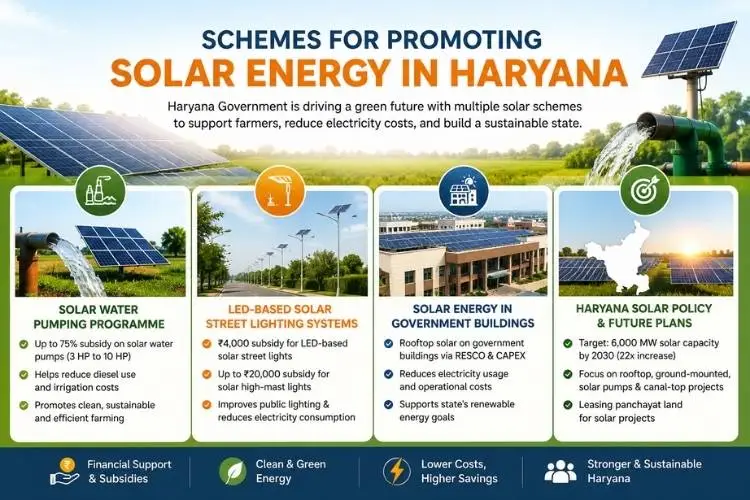
To support sustainable agriculture and reduce diesel consumption, the Department of New & Renewable Energy, Haryana, offers subsidies of up to 75% for solar-powered water pumping systems.
Under this scheme, farmers can install solar pumps ranging from 3 HP to 10 HP capacity for irrigation purposes. The initiative helps farmers lower fuel expenses, reduce operational costs, and improve energy efficiency in rural areas.
The scheme also supports environmentally friendly farming practices by promoting clean and renewable solar energy instead of conventional diesel-powered pumps.
2. LED-Based Solar Street Lighting Systems
The Haryana Government is also promoting solar-powered lighting infrastructure in rural and semi-urban areas through LED-based solar street lighting schemes.
Under this initiative:
- A state subsidy of approximately ₹4,000 is provided for LED-based solar street lighting systems.
- A subsidy of up to ₹20,000 is available for LED-based solar high-mast lighting systems.
These systems help reduce electricity consumption while improving public lighting infrastructure in villages, roads, parks, and public spaces.
3. Solar Energy in Government Buildings
To increase renewable energy adoption across public infrastructure, Haryana is promoting rooftop solar installations on government buildings and institutions using both RESCO (Renewable Energy Service Company) and CAPEXmodels.
This initiative is aimed at:
- Reducing conventional electricity usage
- Lowering operational energy costs
- Increasing the state’s overall solar energy contribution
The program is expected to play an important role in increasing solar adoption across public offices, schools, hospitals, and other government facilities.
4. Haryana Solar Policy & Future Plans
Haryana has set ambitious renewable energy goals under its upcoming solar policy and plans to significantly expand its solar power generation capacity in the coming years.
The state aims to increase solar energy capacity by nearly 22 times, targeting approximately 6,000 MW of installed solar capacity by 2030.
The policy focuses on multiple areas including:
- Rooftop solar installations
- Ground-mounted solar projects
- Solarisation of irrigation pumps
- Canal-top and canal-bank solar plants
- Leasing panchayat land for solar projects
Proposed Solar Capacity Breakdown in Haryana
| Type of Solar Installation | Target Capacity |
| Ground-Mounted Solar | 3.2 GW |
| Rooftop Solar | 1.6 GW |
| Solar-Powered Irrigation Pumps | 1.2 GW |
Major Focus Areas Under Haryana Solar Policy
1. Utility-Scale Solar Projects
The policy aims to support Independent Power Producers (IPPs) to supply solar power directly to DISCOMs. Haryana is also focusing on the development of:
- Solar parks
- Canal-top solar projects
- Water-body-based solar infrastructure
This will help increase large-scale renewable energy generation across the state.
2. Rooftop Solar Systems
To encourage rooftop solar adoption in urban areas, Haryana is exploring advanced billing models such as:
- Virtual Net Metering
- Group Virtual Metering
These systems can help residential societies and shared commercial properties utilize rooftop solar more efficiently.
3. Solar-Powered Agriculture
The Haryana Government is actively promoting all three components of the PM Kusum Scheme to support solar-powered agriculture.
The focus is on:
- Solar irrigation pumps
- Rural solar electrification
- Reducing dependency on diesel and conventional power
This initiative is expected to improve sustainability and energy access in Haryana’s agricultural sector.
Eligibility Criteria for Solar Subsidy in Haryana
To apply for the solar panel subsidy in Haryana, applicants must meet certain eligibility requirements.
Key Eligibility Conditions:
- Applicant must be a resident of Haryana.
- A rooftop solar system should be installed on a residential property.
- The sanctioned electricity load should be within the approved limit.
- The applicant should have a valid electricity connection.
- Income eligibility will be verified through Parivar Pehchan Patra (PPP)
- The solar system must be installed by an approved vendor.
Benefits of Solar Panel Subsidy in Haryana
Installing a rooftop solar system in Haryana offers multiple financial and long-term benefits.
1. Reduce Electricity Bills
Solar panels generate electricity from sunlight, reducing your dependency on grid electricity. Many households can reduce their monthly electricity bills by up to 70–80%.
2. Lower Installation Cost
Government subsidies significantly reduce the upfront cost of installing a rooftop solar system, making solar energy more affordable for homeowners.
3. Long-Term Savings
Solar panels typically last 25 years or more. Once the system cost is recovered, the electricity generated becomes almost free.
4. Environment-Friendly Energy
Solar energy is clean and renewable. It reduces carbon emissions and supports sustainable energy generation.
5. Net Metering Benefits
With net metering, excess electricity generated by your solar system can be exported to the grid, helping you earn electricity credits.
How to Install a Solar System in Haryana
The installation process generally includes the following steps:
Step 1: Site Survey
A solar company visits your property to inspect rooftop space, electricity usage, and sunlight availability.
Step 2: System Design
Based on your requirements, a customized solar solution is designed.
Step 3: Documentation & Approval
The required paperwork and subsidy applications are submitted for approval.
Step 4: Solar Installation
Solar panels, an inverter, a mounting structure, and electrical connections are installed.
Step 5: Net Metering & Inspection
DISCOM officials inspect the system and approve net meter installation.
Step 6: System Activation
Once approved, the solar system starts generating electricity.
How to Apply for Solar Subsidy in Haryana (2026)
Follow these steps to apply for the solar subsidy:
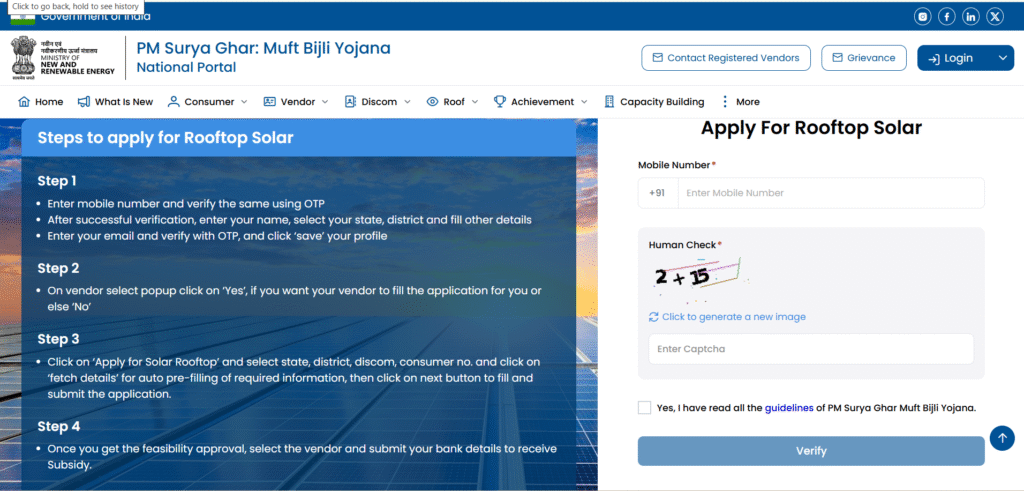
Step 1: Visit PM Surya Ghar Portal
Go to the official PM Surya Ghar portal and click on “Apply for Rooftop Solar”.
Step 2: Register Yourself
Fill in:
- State
- District
- DISCOM
- Consumer Number
- Mobile Number
Step 3: Submit Application
Complete the application form and wait for feasibility approval from DISCOM.
Step 4: Choose Approved Vendor
Install the solar system through a government-approved solar installer.
Step 5: Net Meter Installation
After installation, apply for net metering approval.
Step 6: Upload Bank Details
Submit your bank details and cancelled cheque on the portal.
Step 7: Receive Subsidy
The subsidy amount is transferred directly to your bank account after verification.
Documents Required for Solar Subsidy in Haryana
Here are the commonly required documents:
- Aadhaar Card
- Electricity Bill
- Property Proof
- Bank Passbook / Cancelled Cheque
- Passport Size Photo
- Parivar Pehchan Patra (PPP)
Cost of Solar Systems in Haryana After Solar Subsidy
| System Size | Approximate Cost |
| 1 kW | ₹75,000 – ₹85,000 |
| 2 kW | ₹1.5L – ₹1.7L |
| 3 kW | ₹1.9L – ₹2.15L |
| 5 kW | ₹3.15L – ₹3.57L |
| 10 kW | ₹5.3L – ₹6L |
Final cost depends on:
- Solar panel quality
- Roof type
- Installation complexity
- Subsidy amount
How to Choose the Right Solar Installation Company in Haryana
Choosing the right solar installation company is extremely important for long-term performance and savings. A professionally designed solar system ensures better electricity generation, safety, and durability.
An experienced solar EPC company handles:
- Site inspection
- System design
- Subsidy assistance
- Installation
- Net metering
- After-sales support
Before selecting a vendor, always check:
- Experience
- Certifications
- Warranty support
- Previous projects
- Customer reviews
You can also read our guide on how to find the best solar installation company in Delhi NCR before selecting a solar vendor for your project.
Why Choose Balind Solar Synergy?
Balind Solar Synergy is a trusted solar installation company in Delhi NCR, providing reliable rooftop solar solutions across Haryana and Delhi NCR. The company offers complete end-to-end solar installation services for residential, commercial, and industrial projects.
With expertise in system design, subsidy assistance, net metering, and high-quality installation, the team ensures maximum performance and long-term savings for every customer.
Balind Solar Synergy focuses on:
- Premium quality solar panels
- Professional installation
- Fast project execution
- Complete subsidy support
- Reliable after-sales service
Whether you are planning a residential rooftop solar system or a large commercial project, the company provides customized solar solutions based on your energy requirements.
Talk to a Solar Expert today and get a customized solar solution for your property.
Common Mistakes to Avoid While Applying for Solar Subsidy
Many homeowners face delays or rejection due to small mistakes during the subsidy process.
Avoid these common issues:
- Choosing non-approved vendors
- Incorrect document submission
- Installing systems without DISCOM approval
- Applying incomplete subsidy forms
- Ignoring net metering requirements
Working with an experienced solar company can help avoid these problems.

Conclusion
The solar subsidy in Haryana 2026 provides an excellent opportunity for homeowners to switch to clean and cost-effective energy solutions. With support from both the central and state governments, the cost of rooftop solar installation has become much more affordable.
From reducing electricity bills and increasing energy independence to supporting environmental sustainability, solar energy offers multiple long-term benefits.
If you are planning to install a rooftop solar system in Haryana, this is one of the best times to take advantage of government subsidy schemes and move toward a smarter energy future.
FAQs – Solar Panel Subsidy in Haryana
1. How much subsidy is available for solar panels in Haryana?
Under PM Surya Ghar Yojana, homeowners can receive subsidies up to ₹78,000 depending on the system capacity.
2. Who is eligible for solar subsidy in Haryana?
Residential electricity consumers in Haryana with valid documents and approved rooftop solar installations are eligible.
3. Can I get both a central and Haryana state subsidy?
Yes, eligible families can receive both central and state subsidies according to government guidelines.
4. How much does a 3kW solar system cost in Haryana?
A 3kW rooftop solar system generally costs between ₹1.9 lakh and ₹2.15 lakh before subsidy.
5. Is net metering mandatory for solar subsidy?
Yes, net metering approval is generally required for subsidy processing and electricity export benefits.
6. Which is the best solar company in Haryana?
Choose a company with strong experience, quality products, proper certifications, and reliable after-sales support.
No responses yet