
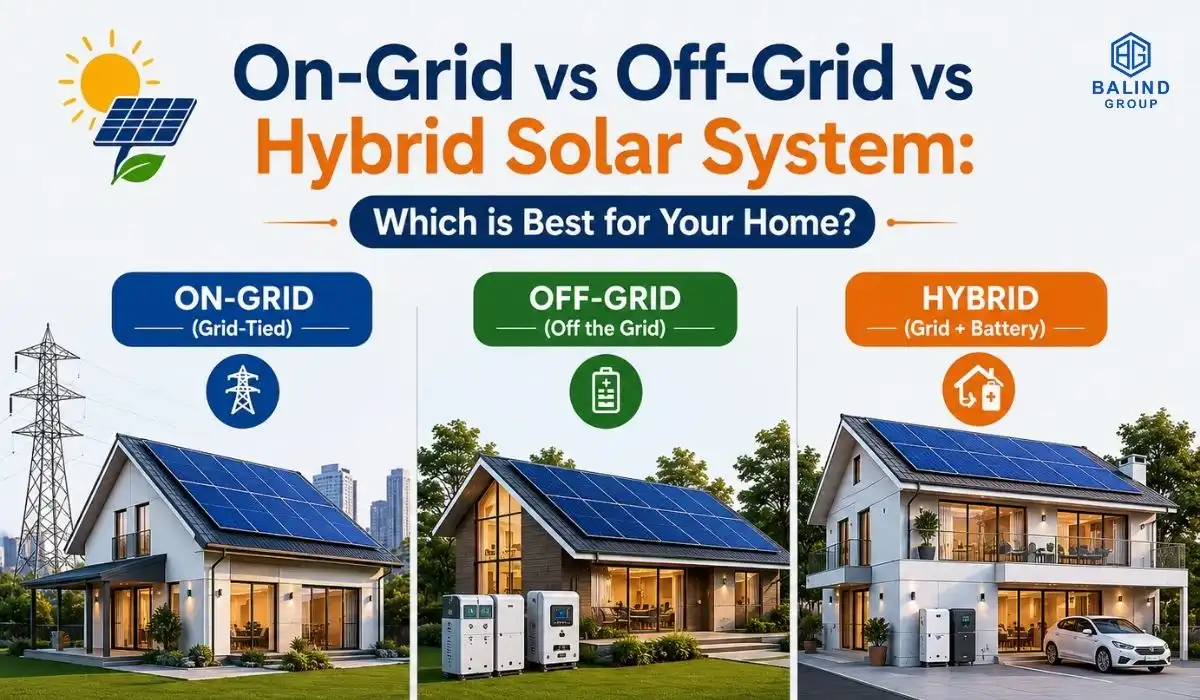
Electricity bills going up every quarter, power cuts during peak summer, and rising fuel costs — sound familiar? With Delhi NCR and most Indian cities facing tariff hikes year after year, rooftop solar has shifted from a “nice-to-have” to a smart financial decision for homeowners.
But the moment you start exploring solar, you hit the same confusing question:
On-grid, off-grid, ya hybrid, which solar system is actually best for your home?
The honest truth is, there’s no one-size-fits-all answer. The right choice depends on your power cut frequency, daily electricity usage, budget, and whether you want to claim the PM Surya Ghar Yojana subsidy. In this guide, we’ll break down each solar system type, compare real Indian costs, and help you make a confident decision.
Quick Comparison: On-Grid vs Off-Grid vs Hybrid Solar System
Here’s a quick snapshot before we dive into the details:
|
Feature |
On-Grid Solar |
Off-Grid Solar |
Hybrid Solar |
| Grid Connection | Yes | No |
Yes |
|
Battery Backup |
No | Yes |
Yes |
| Works During Power Cuts | No | Yes |
Yes |
|
Government Subsidy Eligible |
Yes | No |
Limited |
|
Net Metering |
Yes | No |
Yes |
|
Upfront Cost (3kW) |
₹1.5L – ₹2L | ₹2.5L – ₹3L |
₹2.5L – ₹3.5L |
|
Maintenance |
Low | High |
Medium |
| Best For | Urban homes | Remote areas |
Power-cut prone areas |
What is an On-Grid Solar System?
An on-grid solar system (also called grid-tied solar) is directly connected to your local electricity grid. Your solar panels generate DC power, which the inverter converts into AC for home appliances. Any extra power you don’t consume flows back into the grid, and through net metering, you earn credits on your monthly electricity bill.
It’s the simplest, most affordable, and most popular type of solar system in urban India.
How It Works
Sunlight → Solar Panels → Inverter → Home Appliances → Excess Power Exported to Grid
Pros of On-Grid Solar System:
- Lowest upfront cost (no battery required)
- Eligible for PM Surya Ghar Yojana subsidy up to ₹78,000
- Fastest payback period (3-5 years)
- Net metering significantly reduces monthly electricity bills
- Minimal maintenance, only periodic panel cleaning
Cons of On-Grid Solar System:
- Doesn’t work during power cuts (automatic safety shutdown)
- Fully dependent on grid availability
- No backup option during outages
Best For
Urban homes in Delhi, Gurgaon, Noida, and other Tier-1 cities where grid reliability is good and the primary goal is maximum bill savings.
What is an Off-Grid Solar System?
An off-grid solar system is completely independent of the electricity grid. It uses solar panels, a charge controller, battery storage, and an inverter to power your home 24/7. During the day, solar runs your appliances and charges the batteries; at night, the batteries take over.
There’s no connection to your DISCOM, no monthly electricity bill, and no net metering.
How It Works
Sunlight → Solar Panels → Charge Controller → Battery Bank → Inverter → Home Appliances
Pros of Off-Grid Solar System:
- Complete energy independence
- 100% backup power during outages
- Zero monthly electricity bills
- Perfect for areas with no grid or unreliable supply
Cons of Off-Grid Solar System:
- 60-80% costlier than on-grid systems (because of batteries)
- NOT eligible for PM Surya Ghar Yojana subsidy
- Batteries need replacement every 5-10 years
- Higher maintenance requirements
- Limited capacity during extended cloudy days or monsoon
Best For
Rural areas, farmhouses, hill stations, remote villages, or any property with weak or no grid access.
What is a Hybrid Solar System?
A hybrid solar system combines the best features of on-grid and off-grid setups, it stays connected to the grid AND includes battery backup. It uses a smart hybrid inverter that intelligently manages three power sources: solar, battery, and grid.
When your panels generate surplus power, the system first charges the battery, then exports the rest to the grid. When solar output drops (at night or on cloudy days), the system pulls from the battery first, and only then from the grid. During power cuts, you still get uninterrupted power supply.
How It Works
Sunlight → Solar Panels → Hybrid Inverter → Manages Battery + Home + Grid Simultaneously
Pros of Hybrid Solar System:
- Backup power during grid failures
- Net metering benefits available in most states
- Smart energy management through hybrid inverter
- Future-ready (EV charging compatible)
- Significantly reduces grid dependency
Cons of Hybrid Solar System:
- 40-60% costlier than on-grid solar systems
- Subsidy availability is limited and state-specific
- More complex installation process
- Battery replacement cost over the long term
Best For
Semi-urban homes in Tier-2/3 cities like Faridabad, Ghaziabad, outer Gurgaon, and other parts of NCR where power cuts are frequent. Also ideal for homes running heavy loads like ACs, work-from-home setups, or planned EV chargers.
Cost Comparison in India (2026)
Solar system pricing depends on system size, panel technology (Mono PERC vs TOPCon), and battery chemistry (lithium vs lead-acid). Here’s a realistic 2026 cost estimate for Indian homes:
| System Size | On-Grid | Off-Grid | Hybrid |
| 3kW | ₹1.5L – ₹2L | ₹2.5L – ₹3L | ₹2.5L – ₹3.5L |
| 5kW | ₹2.7L – ₹3.5L | ₹4.5L – ₹6L | ₹4L – ₹5.5L |
| 10kW | ₹5L – ₹6L | ₹8L – ₹10L | ₹7.5L – ₹9L |
After applying the PM Surya Ghar Yojana subsidy (up to ₹78,000), on-grid emerges as the clear winner in terms of payback period. For state-specific subsidy details, eligibility, and the complete application process, check our detailed guide on Solar Subsidy in Haryana 2026: How to Apply, Eligibility & Benefits.
Which Solar System Should You Choose?
Use this quick framework to find your ideal solar system:
Choose On-Grid Solar if:
- You live in a city with 20+ hours of reliable daily power supply
- Your priority is maximum bill savings
- You want to claim government subsidy
- Backup power isn’t critical for you
Choose Off-Grid Solar if:
- You have no grid access (remote farm, village, hill area)
- You want complete energy independence
- You’re okay with higher upfront and replacement costs
Choose Hybrid Solar if:
- You face frequent power cuts (2-6 hours daily)
- You run sensitive appliances or have a work-from-home setup
- You want savings combined with backup security
- You’re planning to install an EV charger in the future
Honestly, for most Indian households dealing with regular power cuts, hybrid hits the sweet spot. The ₹50,000–1,00,000 extra over on-grid buys you genuine peace of mind during outages, and that matters more than people realize until the inverter dies during a 45°C summer.
How Balind Solar Synergy Helps You Choose the Right Solar System
Picking between on-grid, off-grid, and hybrid solar systems isn’t just a technical decision, it impacts your savings for the next 25 years. At Balind Solar Synergy, we’ve built our process around making this choice simple and transparent for every homeowner across Delhi NCR.
Here’s how we help you decide:
- Free Site Assessment — Our team visits your property to evaluate rooftop space, shading, sunlight hours, and load patterns before recommending any system.
- Honest System Recommendation — We analyze your electricity bill, power cut frequency in your locality, and budget to suggest the right system — not the most expensive one.
- Complete Subsidy Support — We handle the entire PM Surya Ghar Yojana paperwork, DISCOM approvals, and net metering applications end-to-end.
- Tier-1 Brand Partnerships — We install only certified panels and inverters from trusted brands like Tata Solar, Adani, Waaree, Vikram Solar, Sungrow, Goodwe, and Deye.
- Fast 15-Day Execution — From site survey to system activation, we deliver complete installations within 15 days.
- End-to-End EPC + After-Sales Support — Design, supply, installation, commissioning, and post-installation monitoring, all under one roof.
With 8+ years of experience and 1000+ rooftop solar installations across Delhi, Gurgaon, Noida, Faridabad, and Ghaziabad, we’ve helped homeowners cut their electricity bills by 70-90% while choosing the system that genuinely fits their needs.
Final Verdict: Our Expert Recommendation for Delhi NCR
Based on 8+ years of installing rooftop solar across Delhi NCR, here’s our honest take:
- For Delhi, South Gurgaon, Central Noida → Go on-grid. Power supply is reliable, and the subsidy makes ROI super fast.
- For Faridabad, Ghaziabad, outer Gurgaon, and Greater Noida → Hybrid is the smarter call. Worth the extra investment.
- For rural Haryana, farmhouses, remote properties → Off-grid with lithium batteries.
If you want to understand the bigger picture of how solar transforms your home’s economics, our breakdown of the Top 10 Benefits of Solar Panel Installation in India walks you through the savings, ROI, and long-term advantages in detail.
FAQs
1. Can I convert my on-grid solar system to hybrid later?
Yes, but it requires replacing the inverter with a hybrid model and adding battery storage. Expect to spend ₹80,000–1,50,000 extra depending on capacity. If you anticipate future backup needs, it’s better to start with hybrid.
2. Is PM Surya Ghar subsidy available for hybrid systems?
Partially. The subsidy is primarily designed for on-grid systems with net metering. Some states allow hybrid systems with grid connection to qualify, but battery costs are typically not subsidized.
3. How long do solar batteries last in hybrid and off-grid systems?
Lead-acid batteries last 4–6 years. Lithium-ion (LFP) batteries last 10–12 years. Lithium is more expensive upfront but cheaper over the system’s lifetime.
4. Which solar system saves the most money long-term?
On-grid saves the most money on paper, lower upfront cost, subsidy support, and net metering. But if power cuts hurt your productivity (work-from-home, business), hybrid often saves more in real terms by preventing downtime.
Ready to Install Solar? Get Expert Advice
Choosing the right solar system is too important to base on guesswork. At Balind Solar Synergy, we conduct free site assessments, analyze your electricity bill patterns, study your local DISCOM’s net metering policy, and recommend the right system, not the most expensive one.
If you’re still unsure which solar company to trust with your project, our complete guide on How to Find the Best Solar Installation Company in Delhi NCR breaks down the exact checks you should run before signing any contract.
No responses yet